
Starting an online business has never been this accessible—but access is not the same as advantage. In 2026, AI can help a solo founder or small team research a market, shape an offer, draft a website, create marketing assets, organize customer support, analyze results, and automate repeatable work. The real opportunity is not to let AI “run the business” for you. It is to use AI as leverage while you stay responsible for the customer, the decisions, and the quality.
That shift is already visible. Intuit QuickBooks’ 2026 AI Impact Report says roughly seven in ten small and midsize businesses surveyed across the U.S., Canada, the U.K., and Australia use AI regularly. OpenAI reported that at least four million people in the U.S. used ChatGPT during March 2026 to help plan, start, run, or grow a business. Shopify’s 2026 ecommerce guidance likewise describes AI as increasingly embedded in marketing, personalization, support, analytics, and store operations.
| ~7 in 10
SMBs across the U.S., Canada, U.K. and Australia used AI regularly in Intuit QuickBooks’ 2026 study. |
4M+
people in the U.S. used ChatGPT in March 2026 to help plan, start, run or grow a business, according to OpenAI. |
3 in 4
ecommerce business owners use AI tools, according to a Shopify merchant survey cited in its 2026 ecommerce AI guide. |
The advantage, then, is not simply having access to AI. The advantage comes from choosing a real problem, validating demand, building a simple offer, and using AI to shorten the distance between an idea and useful evidence.
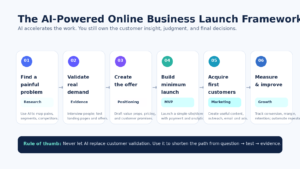
Figure 1. A practical AI-assisted launch framework: research faster, but validate with real people and real behavior.
1. Start With a Problem, Not an AI Tool
A common mistake is to begin with a tool and ask, “What business can I build with this?” A stronger starting point is: “Which customer has a recurring problem that I understand well enough to solve?” AI is excellent for expanding your thinking, but it should not be the only evidence behind your idea.
Use AI for structured market exploration
Give an AI assistant a specific audience and ask it to map jobs-to-be-done, frustrations, existing alternatives, buying triggers, objections, and questions customers are likely to ask before purchasing. Then turn those hypotheses into a research checklist.
- Search real customer conversations in reviews, forums, communities, comments, and Q&A pages.
- Compare competing offers: pricing model, promise, target customer, delivery method, strengths, and gaps.
- Interview potential customers and ask about what they do today—not only whether they “like” your idea.
- Look for signs of existing spend, repeated effort, urgency, or frustration. These are stronger than compliments.
| Useful prompt
“Act as a market research assistant. I want to serve [specific audience]. List their 10 most expensive, frequent, or frustrating problems related to [area]. For each problem, give the current alternatives people use, evidence I should look for, and five interview questions. Treat everything as a hypothesis until I validate it.” |
2. Choose an Online Business Model That Matches the Problem
AI lowers the cost of testing several business models, but the right model depends on the customer’s problem, how urgently they need a solution, how you can deliver value, and what they are willing to pay for.
| Model | Examples | Best fit |
|---|---|---|
| AI-assisted service | Consulting, design, marketing, research, development, virtual assistance | Fastest route to revenue when you already have a skill. |
| Digital product | Templates, guides, toolkits, design assets, spreadsheets, prompt systems | Useful when one solution can be sold repeatedly. |
| Ecommerce | Physical products, niche stores, print-on-demand, branded products | Strong when product demand, logistics, margin, and differentiation are clear. |
| Education | Courses, workshops, communities, coaching | Works best with credible expertise and a defined learning outcome. |
| Micro-SaaS / software | A focused tool that solves one workflow problem | Higher build effort, but recurring revenue may be possible if retention is strong. |
| Content-led business | Newsletter, niche publication, affiliate content, sponsorship, memberships | Requires patient audience building and distinctive expertise. |
3. Validate Demand Before You Build Too Much
AI can make polished websites, ads, mockups, and product descriptions quickly. That creates a new risk: you can build the wrong thing faster. Validation protects you from spending weeks perfecting an offer nobody urgently wants.
Run the smallest credible test
- Write a one-sentence promise: who the offer is for, the result it helps them achieve, and what makes the approach different.
- Create a basic landing page or product page with a clear call to action: join a waitlist, request a quote, book a call, start a trial, or buy.
- Show the offer to a small but relevant group through direct outreach, communities, search, social media, or a modest paid test.
- Measure behavior: replies, qualified conversations, email sign-ups, checkout starts, purchases, or repeat interest.
- Change one assumption at a time—audience, problem, promise, price, channel, or format—and test again.
| What AI should not decide for you
Whether demand is “real.” AI can summarize feedback, cluster objections, and suggest experiments, but only customer behavior can validate your offer. |
4. Build a Minimum Viable Brand and Online Presence
Once you have encouraging evidence, use AI to build the first version of your brand and sales presence. The goal is clarity and credibility, not a giant brand manual.
- Positioning: define the customer, the problem, the promised outcome, and the reason to believe you.
- Naming: generate directions and naming territories, then check trademarks, domains, social handles, and local legal requirements yourself.
- Website/store: create a focused homepage or landing page with one primary action instead of dozens of competing options.
- Sales copy: let AI draft headlines, product descriptions, FAQs, and emails—but edit for accuracy, specificity, and your actual voice.
- Trust: show real examples, screenshots, process details, guarantees you can honor, policies, and clear contact information.
Your minimum launch setup usually needs a domain, website or storefront, payment method available in your market, basic analytics, an email list or CRM, and a simple way to support customers. Avoid buying ten tools before you have ten customers.
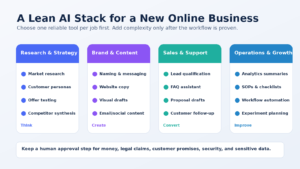
Figure 2. Start with a lean stack: one dependable tool per job, then automate only proven workflows.
5. Use AI to Build a Content System—Not a Content Factory
AI can turn one strong idea into a blog post, video outline, email, carousel, FAQ, and social posts. That is useful leverage. But generic mass production is a weak strategy. Google’s current guidance continues to emphasize helpful, reliable, people-first content, and its 2026 guidance for generative AI features specifically stresses unique, non-commodity content rather than “AEO/GEO hacks.”
A better content workflow
- Start with a real customer question, experience, case study, experiment, dataset, or opinion you can support.
- Use AI to research subtopics, organize the outline, identify missing questions, and challenge your assumptions.
- Add original value: your examples, screenshots, templates, tests, comparisons, mistakes, or expert experience.
- Use AI for editing, repurposing, summaries, metadata, and alternate formats.
- Fact-check the final version and publish under a real author or brand with clear accountability.
| SEO in 2026
Search visibility still starts with useful content, crawlable pages, good page experience, clear structure, and trustworthy information. AI can support that work, but it is not a shortcut around quality. |
6. Acquire Customers With an AI-Assisted Marketing Loop
For a new business, marketing should be treated as a series of small experiments. AI can help create versions quickly, but the market decides which message and channel work.
Search: Create problem-solving pages and product/category content around genuine customer needs. Use Search Console data to learn what people actually find you for.
Short-form content: Turn customer questions, demos, before/after examples, and lessons into short videos or posts. Keep the voice recognizable and human.
Email: Build welcome sequences, lead-nurture messages, abandoned-cart reminders, launches, and customer education—with consent and sensible frequency.
Direct outreach: Research prospects, personalize drafts, and track follow-up. Avoid spammy mass automation that damages reputation.
Partnerships: Use AI to identify complementary creators, businesses, communities, or affiliates, then propose a specific win-win collaboration.
Paid acquisition: Generate ad variations and analyze test results, but start with small budgets until your conversion economics are understood.
7. Use AI for Customer Support Without Making It Impersonal
Customer support is one of the most practical areas for early AI assistance because the work is repetitive and knowledge-based. Start with drafting rather than fully autonomous action.
- Build an FAQ knowledge base from real customer questions, policies, product details, and troubleshooting steps.
- Use AI to draft responses, summarize long threads, translate routine messages, and identify urgent cases.
- Escalate refunds, complaints, safety issues, account access, contractual questions, and unusual cases to a human.
- Review chatbot logs regularly. Every failed answer is a clue about missing documentation or confusing product design.
8. Automate Only After the Manual Process Works
In 2026, agentic tools can complete multi-step tasks across files, apps, browsers, and business systems. That can be powerful, but automation magnifies whatever process you give it. A broken workflow becomes a faster broken workflow.
Begin with repetitive, low-risk tasks: lead routing, meeting summaries, weekly analytics reports, content repurposing, customer-feedback tagging, inventory alerts, or internal checklists. Add approval gates before money moves, messages are sent at scale, data is deleted, customer accounts are changed, or commitments are made.
| Automation rule
Automate repetition, not responsibility. Give AI the narrowest permissions it needs, keep logs, set limits, and make it easy for a human to review, stop, or override the workflow. |
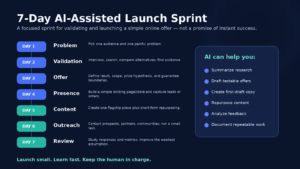
Figure 3. A seven-day sprint can produce evidence quickly. It is a learning plan, not a guarantee of revenue.
9. Track the Numbers AI Cannot Make Disappear
An attractive brand and lots of traffic can still hide a weak business. Use AI to summarize dashboards, explain changes, and generate hypotheses, but keep your attention on the economics.
| Metric | What it tells you |
|---|---|
| Conversion rate | What percentage of qualified visitors or leads become customers? |
| Customer acquisition cost (CAC) | How much does it cost, on average, to acquire a new customer? |
| Gross margin | After direct delivery/product costs, how much value remains to fund operations and growth? |
| Repeat purchase / retention | Do customers return, renew, or continue using the product? |
| Refund / return / churn rate | Where are expectations, quality, onboarding, or fit breaking down? |
| Customer lifetime value (LTV) | What gross value does a customer create over the relationship—not just on the first sale? |
10. Scale the Workflow, Then the Team
When a channel, offer, or process works repeatedly, document it. Ask AI to turn successful work into standard operating procedures, checklists, templates, quality criteria, and onboarding material. This makes it easier to delegate to people or automate selected steps later.
The best use of AI often changes as the business grows: early on, it helps the founder create capacity; later, it helps a team standardize knowledge, analyze more data, and coordinate work. The principle stays the same—AI should amplify a clear process rather than substitute for one.
A Practical AI Tool Stack for 2026
You do not need every tool below. Choose based on your business model, budget, security needs, and regional availability. Product features and pricing change frequently, so verify the current terms before committing.
| Job | Examples | Use |
|---|---|---|
| General AI assistant | ChatGPT, Claude, Gemini | Research, planning, writing, analysis, coding, brainstorming |
| Answer/research tools | Perplexity and search-enabled assistants | Source discovery, research starting points; always verify important claims |
| Design | Canva, Figma and AI image/design tools | Brand drafts, social assets, presentations, landing-page visuals |
| Website / commerce | Shopify, WordPress/WooCommerce, Wix and similar platforms | Storefronts, content sites, checkout and product management |
| Email / CRM | Mailchimp, Klaviyo, HubSpot and alternatives | Lead capture, sequences, segmentation, customer lifecycle |
| Automation | Zapier, Make and native app automations | Move data, trigger workflows, generate recurring reports |
| Analytics | Google Analytics, Search Console and commerce dashboards | Traffic, search visibility, conversion and behavior insights |
Five High-Value Prompts for a New Online Business
| Market validation
“I am considering [offer] for [audience]. Build a validation plan that distinguishes assumptions from evidence. Include 10 interview questions, a competitor comparison framework, three low-cost demand tests, and clear pass/fail signals.” |
| Offer design
“Turn this customer problem into three offer options: entry, core, and premium. For each, define the target result, scope, exclusions, delivery method, likely objections, and what proof I would need before making claims.” |
| Landing page review
“Review this landing-page draft as a skeptical first-time buyer. Identify vague claims, missing trust signals, confusing sections, unanswered objections, and one primary call to action. Do not invent proof or testimonials.” |
| Content plan
“Create a 30-day content plan from these 10 real customer questions. Each topic must teach something useful, include a unique example I can provide, and connect naturally to my product without turning every post into an ad.” |
| Weekly review
“Here are this week’s traffic, leads, sales, refunds, campaign notes, and customer feedback. Summarize what changed, list plausible explanations, separate facts from hypotheses, and recommend the three smallest experiments for next week.” |
Mistakes to Avoid
- Building a full product before testing whether people care enough to act.
- Publishing AI-generated claims, statistics, reviews, or citations without verification.
- Using generic AI content at scale instead of adding original experience, evidence, and perspective.
- Buying a large software stack before the business has repeatable workflows.
- Automating outreach so aggressively that it becomes spam or damages trust.
- Uploading sensitive customer or business information without understanding a tool’s privacy and security settings.
- Letting AI make legal, financial, contractual, or customer-impacting decisions without appropriate human review.
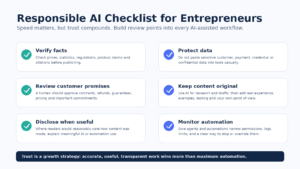
Figure 4. Responsible AI is not a brake on growth; it helps protect the trust that growth depends on.
A Simple 30-Day Launch Plan
Week 1 — Problem & evidence
Choose one audience and problem. Conduct interviews, analyze alternatives, and build a small evidence file. Define what would make you abandon or change the idea.
Week 2 — Offer & MVP
Create the smallest credible offer, price hypothesis, landing page/store, payment path, analytics, and support process. Do not overbuild.
Week 3 — Distribution
Publish useful content, conduct direct outreach, approach partners, and run one controlled acquisition test. Capture objections and questions.
Week 4 — Improve & systemize
Review conversion, customer feedback, delivery effort, margin, and retention signals. Improve the weakest part, document repeatable work, and automate only low-risk repetition.
Frequently Asked Questions
Can AI really help one person start a business?
Yes. AI can give a solo founder more capacity for research, drafting, analysis, design iteration, support, and operations. It does not replace customer insight, expertise, sales judgment, or accountability.
Do I need to know how to code?
No for many online business models. No-code and hosted platforms can handle storefronts, websites, email, payments, and automation. Coding becomes more relevant when software itself is the product or you need custom integrations.
What is the best online business to start with AI?
There is no universal best model. A service can be faster to validate; digital products can scale delivery; ecommerce depends heavily on product economics and logistics; software can offer recurring revenue but requires stronger product execution. Choose based on a real problem and your ability to solve it.
Is AI-generated content bad for SEO?
AI assistance is not automatically a problem. Google’s guidance focuses on whether content is accurate, useful, original, people-first, and created to help users rather than manipulate rankings. Mass-produced low-value content remains risky.
How much should I automate at the beginning?
Usually less than you think. First perform the workflow manually enough times to understand exceptions and quality standards. Then automate the stable, repetitive, low-risk parts.
Final Takeaway
AI has changed the cost and speed of starting an online business in 2026, but it has not changed the fundamentals of entrepreneurship. A business still needs a customer with a meaningful problem, an offer that creates value, a trustworthy way to deliver it, and economics that improve as you learn.
Use AI where it is strongest: exploring options, creating first drafts, organizing information, analyzing patterns, repurposing work, and automating repeatable processes. Keep humans where they are strongest: understanding nuance, building relationships, making accountable decisions, validating reality, and earning trust.
Start small, gather evidence, improve quickly, and let AI multiply a business that deserves to grow.
Sources & Further Reading
- Intuit QuickBooks — 2026 AI Impact Report
- OpenAI — AI is becoming a first hire for small businesses (May 2026)
- OpenAI Academy — Small Business Prompt Pack
- Shopify — AI in Ecommerce: Key Use Cases for 2026
- Google Search Central — Creating Helpful, Reliable, People-First Content
- Google Search Central — Optimizing for Generative AI Features on Google Search
- Google Search Central — Guidance on Generative AI Content
| Editorial note
Statistics in this article are tied to the cited studies and their stated populations/time periods. Tool features, pricing, policies, and regional availability can change; verify current details before publishing commercial claims or committing to a platform. |