
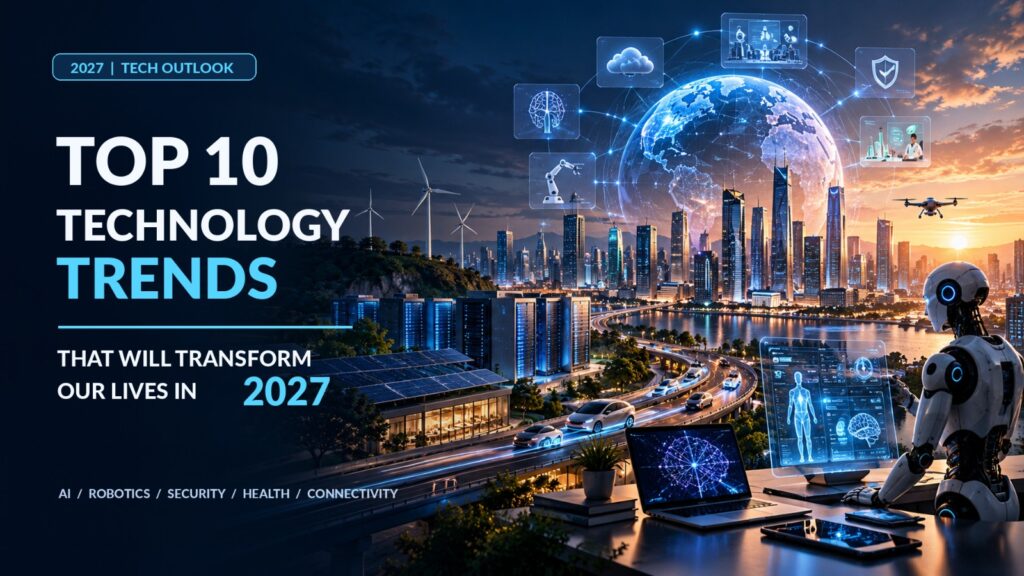
From autonomous AI to smarter healthcare and quantum-ready security—what matters, why it matters, and what to watch next.
Original editorial illustration • Conceptual depiction of possible 2027 technologies, not a photograph of real deployments.
CATEGORY Technology | RESEARCH UPDATED October 30, 2026 | OUTLOOK 2027 (forward-looking)
Technology in 2027: less hype, more everyday impact
Imagine a morning in which an AI assistant reorganizes your schedule, your phone translates a conversation privately, and a health device flags a pattern worth discussing with a clinician. Behind the scenes, software agents coordinate tasks, new security controls verify digital identities, and energy-aware infrastructure works to keep connected services reliable. None of these scenarios requires science fiction—but their availability and quality will vary by product, region and regulation.
The key shift going into 2027 is not simply faster gadgets. It is the combination of more capable AI, stronger digital trust, new computing interfaces and the infrastructure required to support them. Gartner’s October 2026 outlook emphasizes the governance of autonomous systems and AI that reasons beyond text; McKinsey’s 2026 research similarly highlights agentic software, robotics, advanced connectivity and energy technology. [1] [2]
This article is a practical editorial selection of ten trends—not a claim that every technology will become mainstream in 2027. Each section explains a likely direction, real-world usefulness and an important limit to keep in mind.
The 10 trends at a glance
| # | TECHNOLOGY TREND | WHY PEOPLE MAY NOTICE |
|---|---|---|
| 01 | AI agents | Tasks move from suggestions to supervised action |
| 02 | Voice & on-device AI | More private and natural personal computing |
| 03 | AI-native software | Smaller teams prototype and maintain apps faster |
| 04 | Robotics & world models | Machines handle more real-world environments |
| 05 | AI-assisted healthcare | Decision support and monitoring become more useful |
| 06 | Digital identity & cyber defense | Trust and permissions become core features |
| 07 | Quantum-safe security | Critical systems plan encryption upgrades |
| 08 | 5G-Advanced & 6G research | Connectivity evolves; 6G rollout is not imminent |
| 09 | Spatial computing | Digital information moves beyond flat screens |
| 10 | Energy-smart infrastructure | Efficiency becomes a central technology challenge |
1. AI agents move from answering questions to completing tasks
Today’s AI assistants can draft, summarize and recommend. The next step is agentic AI: software that carries out multi-step work using permitted tools, such as comparing travel options, gathering documents, or coordinating a customer-service request. Multiple specialized agents may work together instead of relying on one model for every task. Gartner’s 2027 outlook includes AI context platforms and agent identity—signals that useful autonomy must come with controlled access. [1]
For individuals, the appeal is less administrative friction. For companies, it is faster repetitive workflows and better handoffs. However, an agent can misunderstand instructions, expose sensitive information or take the wrong action if permissions are broad. Human approval, action logs and narrow permissions should remain part of consequential workflows.
What to try: Start with low-risk, reversible tasks: meeting summaries, research organization or a draft itinerary. Review every action before allowing purchases, data sharing or account changes.
2. Voice-first and on-device AI make computing feel more personal
Typing is only one way to interact with technology. Speech reasoning models, contextual assistants and smaller AI models running locally on devices could make phones, earbuds and computers easier to use while moving. A user might ask a follow-up question naturally, translate a conversation, or search personal notes without sending every step to a remote server. Gartner specifically identifies speech reasoning as a 2027 frontier. [1]
On-device processing can help with latency and some privacy needs, but it is not automatically private: data policies, device settings and whether tasks fall back to cloud services still matter. As interfaces become conversational, the winning products will be those that explain what they know, what they store and when they are uncertain.
What to watch: Look for clear offline capabilities, understandable privacy controls, accessibility improvements and a reliable way to verify AI-generated answers.
3. AI-native development changes who can build useful software
Software development is shifting from writing every line manually toward directing, testing and refining code produced with AI assistance. Coding agents can help create prototypes, trace bugs, write tests and document features. Gartner’s 2027 trends include AI coding-agent harnesses and disposable applications; McKinsey calls agentic software development a fast-emerging domain. [1] [2]
That may allow small businesses, students and community groups to build simple, targeted tools that would previously have required larger development budgets. The trade-off is that generated code can introduce security vulnerabilities, unclear ownership, technical debt or subtle errors. Code review, automated tests, accessibility checks and long-term maintenance are still essential skills.
What to try: Use AI to build a small internal dashboard or automate a repetitive spreadsheet task, then review how it behaves with invalid inputs and sensitive data.
4. Physical AI and world models bring intelligence into the real world
Robots are improving at perceiving environments and selecting actions beyond tightly scripted factory movements. World models—systems that learn or simulate how environments change—may help robots and autonomous machines plan in complex settings. The promising near-term examples are controlled settings: warehouses, laboratories, inspection, agriculture and industrial logistics. Both Gartner and McKinsey identify physical AI and robotics as important directions. [1] [2]
The everyday effect could be safer repetitive operations, more consistent deliveries within facilities, and support for workers in hazardous environments. But a dramatic robot demonstration does not prove dependable performance in an unpredictable home or crowded public street. Safety testing, supervision, cost and accountability will determine adoption.
What to watch: Measure real deployment reliability and worker safety—not only viral videos of humanoid robots.

Physical AI illustration: connected machines, robotics and decision-support interfaces in a future smart-city environment.
5. AI-enhanced healthcare supports clinicians and informed patients
In healthcare, AI is already used in authorized products for image analysis, monitoring and other clinical tasks. The US Food and Drug Administration maintains a public list of AI-enabled medical devices, showing that this is an existing regulated field rather than a purely futuristic idea. [3] In 2027, further progress may come from more useful decision-support tools, remote monitoring and clinical workflows that connect patient information responsibly.
For a patient, the benefit could be faster review of some scans, more useful monitoring alerts or more accessible follow-up information. The key boundary is medical reliability: an AI-generated suggestion is not a diagnosis, and bias, poor data quality and inappropriate automation can cause harm. Clinicians should remain responsible for medical decisions, and sensitive health data deserves extra protection.
What to watch: Prefer validated, appropriately regulated health tools and ask what evidence supports their intended use, rather than relying on generic chatbots for diagnosis.
Illustrative research setting: clinician reviewing AI-assisted medical images and wearable-health information.

6. Cybersecurity becomes proactive—and digital identities become more important
As more apps, devices and AI agents act on users’ behalf, knowing who or what is allowed to take an action becomes critical. Expect more attention to identity verification, permission management, content provenance and defenses that identify suspicious behavior before a breach. Gartner highlights agent identity and autonomous exposure remediation as 2027 priorities. [1]
For everyday users, this may appear as safer sign-in experiences, stronger account recovery, warnings about manipulated media, and clearer prompts before an automated assistant accesses files or sends information. No single AI-powered security tool will eliminate phishing or fraud. Good security still relies on updates, unique credentials, multifactor authentication and skeptical review of urgent requests.
What to do now: Enable passkeys or phishing-resistant authentication where available, update devices, and review which apps or agents can access private accounts.
7. Quantum-safe security matters before quantum computers become commonplace
Quantum computing attracts attention because of its long-term potential for certain scientific and optimization tasks. But consumers should not expect a general-purpose quantum computer at home in 2027, or assume that every high-profile demonstration proves commercial advantage. The more immediate issue is encryption: some widely used public-key approaches may be vulnerable to sufficiently capable future quantum machines.
In October 2026, the US National Institute of Standards and Technology published guidance on transitioning to post-quantum cryptographic standards, following the first finalized standards released in 2024. [4] This is a practical modernization effort for software providers, banks, governments and other organizations that need data to stay confidential for years.
What to watch: Look for responsible migration plans from service providers—not claims that the internet’s encryption will suddenly fail in 2027.
8. 5G-Advanced progresses while the groundwork for 6G continues
Mobile networks will keep improving capacity, reliability and efficiency, with many gains coming through the ongoing evolution of 5G and network architecture. Meanwhile, 6G—called IMT-2030 in international standardization—is still being defined. In March 2026, the International Telecommunication Union reported progress on draft technical requirements and six envisaged usage scenarios for the next generation. [5]
The future uses could include immersive communication, more reliable connections for industry, wider coverage and integration of sensing with communications. For a reader in 2027, the grounded expectation is better use of existing networks and continued 6G research—not universal commercial 6G service. Device compatibility, pricing, spectrum and geography will shape the experience.
What to watch: Coverage quality, affordability and actual latency matter more than headline peak speeds.
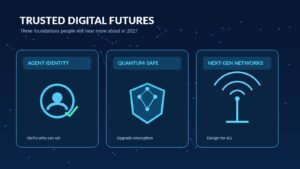
Conceptual guide to agent identity, quantum-safe encryption and next-generation networks—three distinct technology priorities.
9. Spatial computing and wearables put digital information in context
Spatial computing aims to place digital content where it is useful in the physical world. Through mixed-reality headsets, smart glasses and other wearable interfaces, a technician might see repair instructions over equipment; a student might explore a three-dimensional model; or a traveler might follow an unobtrusive translation overlay. McKinsey includes immersive-reality technologies among the frontiers it tracks. [2]
The challenge is moving from impressive demos to comfortable, affordable and socially acceptable products. Battery life, accessibility, safety around distractions and privacy for bystanders are not minor details. In 2027, specialized workplace and training uses may be easier to justify than a universal replacement for the smartphone.
What to watch: Products that solve one real task effectively—hands-free instructions, training or navigation—rather than promising an all-purpose virtual world.
10. Energy-smart AI and infrastructure become part of the technology story
Digital innovation depends on physical systems: chips, data centers, electric grids, cooling and reliable networks. AI demand is making this connection more visible. The International Energy Agency projects that worldwide data-center electricity use could more than double to about 945 terawatt-hours by 2030 in its base case, with AI a major driver. That figure is a projection, not a 2027 measurement. [6]
Efficiency will therefore matter alongside capability. Better chips, careful workload scheduling, efficient cooling, renewable electricity and smarter grid operations can reduce some pressures. Connected sensors may also help cities monitor transport, water and energy consumption. The meaningful question is not whether a service uses AI, but whether it delivers enough public or business value to justify its cost, resource use and maintenance.
What to watch: Transparent energy reporting, efficient design and useful local smart-city projects with measurable results.
Editorial depiction of connected urban infrastructure, solar power and wind generation alongside data-intensive services.

How to prepare for 2027 without chasing every headline
Focus on durable skills: digital literacy, privacy awareness, critical thinking and the ability to test AI-assisted work. Individuals can experiment with one genuinely useful AI workflow, secure important accounts and learn how automated decisions are made. Businesses can audit their data, identify tasks suitable for supervised automation and set clear responsibilities for safety, cost and compliance. Communities should ask whether proposed smart-city projects improve an actual service—and for whom.
Technology is most transformative when it becomes trustworthy, accessible and useful. The next year will likely bring a mixture of better everyday tools and ambitious pilots that still need time. The strongest strategy is curiosity backed by evidence, not predictions treated as promises.
Final perspective
The most important technology story of 2027 may not be a single breakthrough. It may be the moment organizations become more deliberate about how autonomous software, intelligent machines, private data, networks and physical infrastructure work together. If innovation is measured by practical benefits rather than spectacle, the coming year has plenty worth watching.
Sources and further reading
[1] Gartner, Top Strategic Technology Trends for 2027 (Oct. 20, 2026).
[2] McKinsey, Technology Trends Outlook 2026.
[3] U.S. FDA, List of Artificial Intelligence-Enabled Medical Devices.
[5] ITU, IMT-2030: Technical Requirements for the 6G Future (Mar. 17, 2026).
[6] International Energy Agency, Energy and AI, Executive Summary.
PUBLISHING NOTES / REMOVE BEFORE POSTING
SEO & Google Search publishing checklist
These optional editorial notes support publishing but are not part of the article body. Google does not guarantee rankings for any specific formatting or content strategy; prioritize original value, accuracy and a good reading experience. [7] [8]
Suggested SEO title: Top 10 Technology Trends for 2027: AI, Robotics & More
Suggested URL slug: top-10-technology-trends-2027
Primary search intent: Informational: practical technology trends expected to matter in 2027
Suggested meta description: Explore 10 technology trends for 2027, from AI agents and robotics to quantum-safe security, healthcare, 6G research and sustainable computing.
Suggested excerpt: What will technology look like in 2027? Discover ten researched trends, their everyday benefits, limitations and the steps worth taking now.
Category / suggested tags: Technology / AI trends, technology 2027, robotics, cybersecurity, digital future
Cover image alt text: Futuristic connected city with robotics, clean energy and technology interfaces illustrating 2027 trends
Hero image dimensions: 1920 × 1080 pixels; compressed JPG, 16:9 landscape
Before publishing
- Add a real author name, relevant expertise, and a publication / update date; do not invent credentials or first-hand testing.
- Check every date-sensitive claim and source link immediately before publishing in 2027.
- Use one H1 on the web page, descriptive H2 headings, a responsive image element, alt text and fast-loading images.
- Add only genuinely relevant internal links to existing articles on your website; avoid keyword stuffing and misleading promises.
- Provide sufficient information on 2027 forecasts, including uncertainty and geographical variation.
- Do not publish this checklist as article body.
[7] Google Search Central: Creating helpful, reliable, people-first content.
[8] Google Search Central: Image SEO best practices.
Frequently Asked Question
AI agents, voice-based assistance and improvements to existing devices are among the most immediately visible possibilities, because they build on products people already use. Impact will differ by country and access.
No credible evidence supports a sudden replacement of all jobs. Many tasks may change or be partially automated, while human oversight, interpersonal skills, deployment cost and regulation remain important.
No. 6G is still under international development and standardization. Network upgrades and 5G evolution are more realistic near-term expectations.
Not as a general claim. The near-term priority is preparing to migrate vulnerable cryptographic systems to post-quantum standards before sufficiently capable quantum threats emerge.