
Artificial Intelligence (AI) is rapidly transforming the technology industry, and software development is among the fields experiencing some of the most significant changes. Tasks that once required hours of manual coding, debugging, and documentation can now be supported by intelligent AI-powered tools capable of understanding instructions, generating code, identifying errors, and assisting developers throughout the development process.
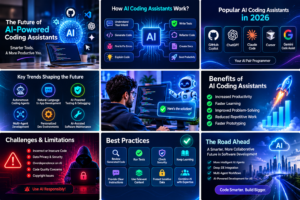
AI-powered coding assistants have evolved beyond simple code-completion features. Modern systems can understand programming requirements, analyze existing codebases, suggest architectural improvements, generate automated tests, and even execute multi-step development tasks with limited human intervention.
Tools such as GitHub Copilot, ChatGPT and OpenAI Codex, Claude Code, and Cursor demonstrate how AI is becoming an increasingly important part of modern programming workflows.
According to the 2026 Stack Overflow Developer Survey, approximately 66% of respondents use AI coding assistants or coding agents, and 73% of those users reported using these tools daily. These findings demonstrate that AI-assisted programming is becoming a regular part of software development rather than simply an experimental technology.
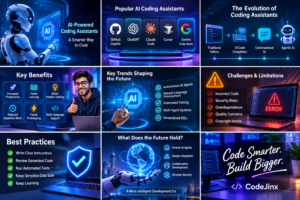
But this raises an important question:
Are AI-powered coding assistants simply making developers more productive, or are they changing the entire future of software engineering?
Let’s explore how these technologies work, where they are heading, and what developers should expect in the coming years.
- What Are AI-Powered Coding Assistants?
AI-powered coding assistants are intelligent software tools that use artificial intelligence and machine learning models to help developers perform programming-related tasks.
They analyze natural-language instructions, programming syntax, project files, and surrounding code to generate relevant suggestions and solutions.
Unlike traditional code editors, which primarily provide syntax highlighting and basic autocomplete functionality, modern AI assistants can understand more context and help with complex programming activities.
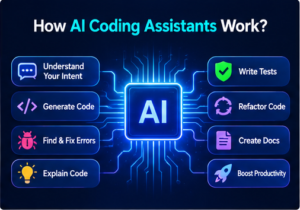
Their common capabilities include:
- Code Generation: Creating code from natural-language instructions.
- Code Completion: Predicting and suggesting the next lines of code.
- Debugging: Identifying potential errors and recommending fixes.
- Code Explanation: Explaining unfamiliar functions, classes, and algorithms.
- Automated Testing: Generating test cases and identifying possible edge cases.
- Code Refactoring: Improving code structure, readability, and maintainability.
- Documentation: Creating technical documentation and code comments.
For example, a developer can write:
“Create a user registration system using React, PHP, and MySQL with input validation.”
An AI coding assistant can generate a starting implementation, suggest the required components, and help explain how the frontend communicates with the backend.
However, the generated result still requires testing, security review, and human validation before it is used in a production application.
- The Evolution of Coding Assistants
AI-powered programming tools have developed through several stages. Understanding this evolution helps explain why their future capabilities could be so significant.
Stage 1: Traditional Code Editors
Earlier development environments primarily focused on writing and managing source code.
Developers relied on features such as syntax highlighting, basic autocomplete, debugging tools, and compiler error detection.
Tools such as Visual Studio Code, Eclipse, and IntelliJ IDEA helped improve the development experience, but developers still performed most programming tasks manually.
Stage 2: AI-Based Code Completion
The introduction of machine-learning-powered coding assistants brought a major improvement to development workflows.
Instead of manually writing every line of code, developers could receive intelligent suggestions based on their current code and programming context.
GitHub Copilot became one of the prominent examples of this generation, helping developers generate functions, complete statements, and explore programming solutions.
Stage 3: Conversational AI Programming
The next stage introduced natural-language interaction with AI models.
Developers could ask questions, share code snippets, request explanations, and receive suggested implementations through conversational interfaces.
This made programming assistance more accessible to beginners and experienced professionals alike.
Stage 4: Agentic AI Coding Assistants
The latest evolution involves AI coding agents that can handle more complex, multi-step tasks.
Rather than only suggesting individual lines of code, these systems can work with project files, plan changes, execute commands, run tests, and revise their implementations.
This development represents a shift from AI-assisted coding toward agentic software development, where developers increasingly guide and supervise AI-driven workflows.
- Leading AI Coding Assistants in 2026
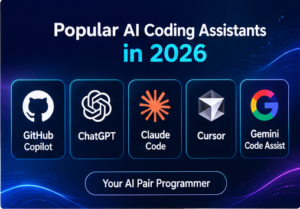
The AI coding ecosystem includes several powerful tools designed for different development requirements.
- GitHub Copilot
GitHub Copilot provides AI-powered code suggestions, conversational assistance, and agentic development capabilities within supported development environments.
It is useful for developers who want assistance with code completion, debugging, documentation, and everyday programming tasks.
- ChatGPT and OpenAI Codex
ChatGPT can assist with programming explanations, debugging, algorithm development, and technical problem-solving.
OpenAI Codex provides an agent-based approach to software engineering tasks, helping developers work through implementation and codebase-related activities.
- Claude Code
Claude Code is an AI coding agent designed to work with project files and developer tools. It can assist with understanding codebases, implementing changes, debugging, and executing development workflows.
- Cursor
Cursor is an AI-focused code editor that integrates AI capabilities into the programming environment. It helps developers understand existing projects, generate code, and make changes across multiple files.
- Gemini Code Assist
Gemini Code Assist provides AI-powered development support, including code generation, explanations, and assistance with programming workflows.
Important: These tools offer different capabilities, integrations, pricing models, and usage limits. Developers should evaluate them according to their programming languages, project requirements, security needs, and preferred workflow.
- Major Trends Shaping the Future of AI Coding Assistants
The future of AI-powered programming is not limited to generating code faster. Several emerging trends are expected to reshape how software is designed, developed, tested, and maintained.
- Autonomous AI Coding Agents
One of the most important developments is the emergence of autonomous coding agents.
Traditional coding assistants respond to individual instructions. AI agents can approach a task as a sequence of connected activities.
For example, when asked to develop a login system, an AI agent may:
- Analyze the existing project structure.
- Identify the required frontend and backend components.
- Create the login interface.
- Implement authentication logic.
- Connect the application to a database.
- Generate relevant test cases.
- Run tests and investigate failures.
- Present the changes for developer review.
This approach can reduce repetitive development work and make complex projects easier to manage.
However, autonomy does not mean that human supervision is unnecessary. Developers still need to define requirements, control permissions, evaluate results, and approve important changes.
- Natural-Language-to-Application Development
Another important trend is the growing ability to transform natural-language instructions into functional software components.
Instead of manually writing every function, developers can describe what they want to build.
For example:
“Build a student management dashboard with administrator login, student registration, attendance tracking, and result management.”
An AI assistant may help generate the initial application structure, database models, interfaces, and backend logic.
This development could make software creation more accessible to students, entrepreneurs, designers, and non-technical professionals.
However, complex applications still require proper architecture, security, data management, and software engineering expertise.
- AI-Powered Automated Testing and Debugging
Testing and debugging are essential parts of software development, but they can consume considerable time.
Future coding assistants are expected to become more capable of identifying errors, generating test cases, analyzing application behavior, and recommending fixes.
For example, an AI system may identify a possible null-value error, generate a test case that reproduces the problem, suggest a correction, and help verify whether the correction works.
The goal is to make software testing more continuous and integrated into the development process.
- Multi-Agent Software Development
A particularly interesting direction is the development of multi-agent systems.
Instead of relying on a single AI assistant, developers may use multiple specialized agents that collaborate on different parts of a project.
For example:
| AI Agent | Responsibility |
| Planning Agent | Analyzes requirements and creates development tasks |
| Frontend Agent | Develops user interfaces |
| Backend Agent | Implements APIs and business logic |
| Database Agent | Designs database structures and queries |
| Testing Agent | Generates and executes test cases |
| Review Agent | Examines code quality and potential problems |
These agents can exchange information and coordinate their work under an overall development workflow.
Such systems could improve the speed of complex development projects, although coordination errors and inconsistent implementations remain important challenges.
- Personalized AI Development Environments
Future coding assistants may provide increasingly personalized development experiences.
They could adapt to a developer’s preferred programming language, coding style, project structure, frameworks, and frequently used libraries.
For example, a developer who regularly works with React, Node.js, and MongoDB could receive suggestions tailored to those technologies and existing project conventions.
This could reduce repetitive instructions and make AI-generated code more consistent with individual or organizational standards.
- AI-Assisted Software Maintenance
Writing new software is only one part of software engineering. Maintaining existing applications is equally important.
Large applications often contain outdated dependencies, technical debt, undocumented functions, and legacy code.
AI coding assistants could help developers understand older systems, update dependencies, identify potential bugs, improve documentation, and suggest refactoring strategies.
This is particularly useful for organizations that manage complex software systems and long-running applications.
- How AI Coding Assistants Will Change the Role of Software Developers
One of the biggest discussions surrounding AI in programming is whether these tools will replace software developers.
The more useful question is how they will change the responsibilities of developers.
As AI becomes more capable of handling repetitive implementation tasks, developers may spend more time on activities that require broader technical understanding and decision-making.
These responsibilities include:
- System Architecture: Designing scalable and maintainable software systems.
- Problem-Solving: Understanding complex requirements and selecting suitable solutions.
- Code Review: Evaluating AI-generated implementations.
- Security Engineering: Identifying vulnerabilities and protecting sensitive information.
- Technical Leadership: Coordinating development workflows and making architectural decisions.
- AI Integration: Using AI tools effectively within software development environments.
The role of a developer is therefore likely to evolve from writing every line of code toward designing, directing, reviewing, and maintaining software systems.
AI may automate certain programming activities, but strong software engineering knowledge will remain essential for building reliable products.
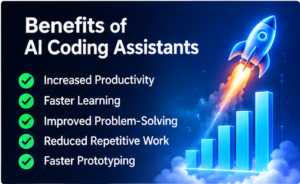
- Benefits of AI-Powered Coding Assistants
AI coding assistants offer several important advantages for individuals and development teams.
Increased Productivity
Developers can use AI to generate repetitive code, create initial implementations, and explore possible solutions more quickly.
Faster Learning
Beginners can request explanations of unfamiliar concepts, programming syntax, algorithms, and frameworks.
Improved Problem-Solving
AI tools can suggest alternative approaches, explain errors, and help developers investigate difficult programming problems.
Reduced Repetitive Work
Tasks such as generating boilerplate code, writing basic documentation, and creating routine test cases can receive AI assistance.
Faster Prototyping
Developers can create early versions of applications and test ideas without manually implementing every component from scratch.
Support for Multiple Programming Languages
Many AI assistants can help developers work across different programming languages, frameworks, and technology stacks.
- Challenges and Limitations of AI Coding Assistants
Despite their advantages, AI-powered coding assistants are not perfect. Their widespread adoption also introduces technical, ethical, and professional challenges.
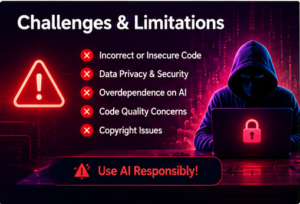
- Incorrect or Insecure Code
AI-generated code may contain logical mistakes, outdated practices, or security vulnerabilities.
Developers should never assume that generated code is correct simply because it looks professional.
- Data Privacy and Security
Some development tasks involve confidential source code, customer information, database credentials, or proprietary business logic.
Sharing sensitive information with external AI services without authorization can create serious privacy and security risks.
Organizations should establish clear policies regarding data access, retention, and approved AI tools.
- Overdependence on AI
Excessive dependence on coding assistants can weaken a developer’s ability to solve problems independently.
Students, especially, should understand the concepts behind generated code instead of simply copying and submitting AI-produced solutions.
- Code Quality and Maintainability
AI-generated code may work for a simple demonstration but still contain inefficient algorithms, unnecessary dependencies, poor architecture, or inconsistent coding patterns.
Human review and proper testing remain essential.
- Copyright and Licensing Concerns
AI-generated software can raise questions about intellectual property, licensing compatibility, and the origin of suggested code.
Developers and organizations should review relevant licensing and usage requirements before adopting generated code in commercial products.
The key principle is simple: AI can assist with software development, but accountability for the final application must remain with the people and organizations building it.
- Best Practices for Using AI Coding Assistants
To benefit from AI-powered development without compromising software quality, developers should adopt a responsible workflow.
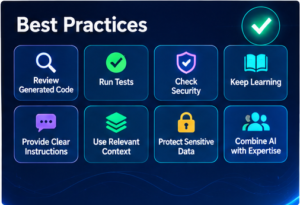
- Write Clear Requirements: Provide specific instructions, expected behavior, and technical constraints.
- Provide Relevant Context: Share appropriate project documentation, file structures, and coding conventions.
- Break Complex Tasks into Smaller Steps: Avoid giving an AI assistant unrestricted responsibility for an entire application.
- Review Generated Code: Understand the implementation before accepting significant changes.
- Run Automated Tests: Validate functionality using unit tests, integration tests, and relevant test cases.
- Check Security: Review authentication, authorization, database queries, dependencies, and input validation.
- Protect Sensitive Information: Never expose passwords, API keys, private credentials, or confidential data without proper authorization.
- Keep Learning: Strengthen programming fundamentals, algorithms, data structures, and software engineering concepts.
A productive AI-assisted workflow should combine automation with human judgment rather than replace engineering discipline.
- What Does the Future Hold?
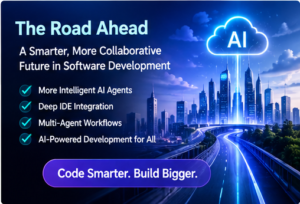
The future of AI-powered coding assistants will likely involve more intelligent, context-aware, and collaborative development environments.
Several developments are worth watching:
Longer-running coding agents: AI agents may become increasingly capable of handling complex projects over extended periods, with developers providing direction and reviewing important decisions.
Deeper development environment integration: AI tools may become more closely connected to code editors, version control systems, testing platforms, project management tools, and deployment pipelines.
More sophisticated code understanding: Better context management may help AI systems understand large codebases, project dependencies, technical documentation, and organizational coding standards.
Collaborative AI development: Multiple agents may work together on frontend, backend, testing, and documentation tasks.
Stronger governance and security: As companies adopt AI-driven development, permission management, audit trails, validation, and security controls are likely to become increasingly important.
These developments are not guaranteed outcomes, but they represent important directions in the ongoing evolution of AI-assisted software engineering.
- Should Students and Developers Learn AI Coding Tools?
Absolutely. Understanding how to use AI coding assistants is becoming a valuable professional skill.
However, learning an AI tool should not replace learning programming itself.
Computer science students should first develop a strong understanding of programming fundamentals, object-oriented programming, data structures, algorithms, databases, and software development principles.
Once these foundations are established, AI assistants can help accelerate learning and improve practical development skills.
For students, a good approach is to:
- Build small projects using AI-assisted development.
- Ask AI to explain the generated code.
- Solve programming exercises independently.
- Compare AI-generated solutions with manually written implementations.
- Learn debugging and testing instead of relying entirely on automated suggestions.
- Experiment with different AI coding environments.
The developers who understand both software engineering and AI-assisted workflows will be better prepared for an increasingly intelligent development environment.
Conclusion
AI-powered coding assistants are transforming software development from a process focused primarily on manual code writing into a more collaborative environment involving intelligent automation, code generation, testing, debugging, and agent-based workflows.
Their future is not simply about writing code faster. It is about helping developers manage complexity, explore solutions, improve productivity, and build software more efficiently.
Nevertheless, successful software development will continue to require human judgment, creativity, technical knowledge, security awareness, and accountability.
AI should be viewed as a powerful development partner rather than a complete replacement for software engineering expertise.
The future developer will not necessarily be the person who writes the most code, but the person who understands problems, designs effective solutions, and uses intelligent tools responsibly.
The future of programming is not just about coding with AI. It is about becoming a better engineer with AI.
Final Thoughts
AI-powered coding assistants are opening new opportunities for students, developers, startups, and technology organizations. Learning to use these tools effectively while maintaining strong engineering fundamentals can help developers remain adaptable in the evolving software industry.
Stay curious. Keep learning. Build smarter with AI.
Explore more technology insights, programming guides, and AI resources on CodeJinx.com.
An AI-powered coding assistant is a software tool that uses artificial intelligence to help developers generate code, complete programming tasks, debug errors, explain code, and improve development workflows.
Some widely recognized AI coding tools include GitHub Copilot, Claude Code, OpenAI Codex, Cursor, and Gemini Code Assist. Their suitability depends on individual development requirements.
AI coding assistants can automate or accelerate certain programming tasks, but they cannot reliably replace the full responsibilities of software developers. Architecture, complex decision-making, security, and accountability still require human expertise.
AI-generated code can be useful, but it may contain logical errors, security vulnerabilities, or inefficient implementations. Developers should always review, test, and validate generated code.
Yes. They can explain programming concepts, provide examples, assist with debugging, and help beginners understand unfamiliar code. However, beginners should practice programming independently to develop strong technical foundations.
Developers should focus on programming fundamentals, problem-solving, algorithms, system design, software testing, cybersecurity, and effective AI tool usage.