
A practical guide to customer intent, creative strategy, advertising costs, and profitable online growth.
A shopper spots a stylish backpack in an Instagram Reel but does not buy it. Two days later, they
search for “waterproof travel backpack” and click a product ad. Social media created the
curiosity; search captured the intent. For an online business, knowing when each channel helps
is more useful than asking which platform wins every time.
Social media ads and search ads can both increase e-commerce sales—but they reach people in
different moments of the buying journey. The best choice depends on what you sell, whether
customers already know they need it, how you tell your story, and how profitably you can turn
attention into orders.
FIELD NOTES / DIGITAL COMMERCE
SOCIAL MEDIA ADS × SEARCH ADS • OCTOBER 2026
What Is the Difference Between Social Media Ads and Search Ads?
Social media ads: create discovery and demand
Social media advertising places sponsored content within feeds, Stories, short-form videos, and
other experiences on platforms such as Facebook, Instagram, TikTok, and Pinterest. Advertisers
can use audience signals and automated delivery systems to reach people likely to engage or
purchase, even when they are not actively shopping.
The creative is often the advertisement: a compelling demonstration, before-and-after story,
creator review, or product video can make someone stop scrolling. Social ads are particularly
useful for new brands, visually distinctive products, launches, and audiences who do not yet
know your solution exists.

Social media ads can spark product discovery through visually engaging creative.
Search ads: capture existing buying intent
Search advertising appears when someone enters a relevant query on a search engine such as
Google or Bing. A store might advertise for searches like “buy noise-cancelling headphones” or
“organic cotton bedsheets online.” The query often reveals a clearer immediate need than a
passive social feed impression.
Traditional search campaigns commonly feature keyword-related text ads. Retailers may also
use Shopping ads, which display product details and images, but Shopping is a distinct Google
Ads campaign approach. Both can help people find relevant products when they are researching
or ready to buy.

FIELD NOTES / DIGITAL COMMERCE
SOCIAL MEDIA ADS × SEARCH ADS • OCTOBER 2026
Search ads help online stores appear when customers express relevant demand.
Social Media Ads vs. Search Ads: Side-by-Side Comparison
Factor Social Media Ads Search Ads
Customer mindset
Browsing, discovering, being
inspired
Actively asking, comparing, or
buying
Primary advantage
Generate awareness and new
demand
Capture demand that already exists
Typical creative
Video, images, carousels, creator
content
Keyword-relevant text; related
Shopping formats
Key signal
Audience and engagement signals,
automated delivery
Search query and keyword relevance
Best suited to
Visual products, launches, lifestyle
brands
Products with clear, searchable
demand
Main challenge
Standing out and converting cold
audiences
Competition and limited search
volume
What to measure
Purchases, new-customer cost,
creative effectiveness
Purchases, query quality, conversion
value
Neither platform guarantees cheaper customers or a higher return. Cost-per-click (CPC), cost-peracquisition (CPA), and return on ad spend (ROAS) change with competition, audience, product
price, creative quality, seasonality, and website experience.
FIELD NOTES / DIGITAL COMMERCE
SOCIAL MEDIA ADS × SEARCH ADS • OCTOBER 2026
When Social Media Ads Are the Better Starting Point
Choose social first when your product benefits from being seen, demonstrated, or explained.
Think skincare routines, handmade home décor, fashion accessories, fitness products, or a newly
launched lifestyle brand. Short videos, testimonials, and strong product photography can create
desire before shoppers know what to search for.
You are introducing an unfamiliar product or building a new brand.
Your product looks compelling in photos, short videos, or real-life use.
Your buyers are influenced by storytelling, community, or social proof.
You can produce and test several creative concepts rather than relying on one ad.
The trade-off: attention is not the same as purchase intent. A successful social campaign needs a
convincing offer, an easy mobile shopping experience, and measurement that extends beyond
likes or video views.
When Search Ads Are the Better Starting Point
Choose search first when people already use clear terms to find what you sell. Examples include
replacement laptop batteries, specific fitness equipment, running shoes by size, or a recognizable
product category with established demand.
Customers already search for the product, problem, or category.
You can identify relevant, commercially meaningful queries.
Your product pages answer buyers’ questions and make comparison easy.
You want to prioritize people closer to a decision or purchase.
The trade-off: search cannot create unlimited demand. Popular keywords can also be
competitive, so keyword relevance, negative keywords, pricing, shipping details, and landingpage quality matter.
Which One Is More Cost-Effective? Look Beyond Clicks
A cheaper click is not necessarily a cheaper sale. Evaluate the full path from an ad impression to
a paid order, then compare performance with the profit available on each order.
Simple profit check
Imagine a store sells an item for $100 and spends $60 on product cost, fulfillment, and other
variable expenses. That leaves $40 before advertising and fixed overhead. The break-even ad
CPA is therefore at most $40, equivalent to a 2.5x ROAS. A business usually needs a stronger
result to cover overhead and earn profit. This example is illustrative, not an industry
benchmark.
CPA (cost per acquisition): Ad spend divided by attributable purchases.
FIELD NOTES / DIGITAL COMMERCE
SOCIAL MEDIA ADS × SEARCH ADS • OCTOBER 2026
ROAS (return on ad spend): Attributable revenue divided by ad spend.
Conversion rate: Purchases divided by visits or clicks, depending on your measurement
definition.
Contribution margin and customer lifetime value: Whether sales are profitable now or over
repeat purchases.
Because buyers may encounter several ads before purchasing, use consistent conversion
tracking, tagged links, and store-level sales data. Treat platform-reported attribution as useful
evidence—not a complete picture of incremental sales.
The Strongest E-Commerce Approach Often Uses Both
For many brands, the channels work better as a connected journey rather than competing silos.
Social creative introduces the product, helpful landing pages build trust, and search ads make
the brand easy to find when curiosity becomes a specific need.
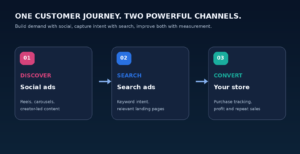
A simple full-funnel approach: discovery, active search, and conversion measurement.
Discovery: Introduce your best product with engaging social videos, photos, and authentic
reviews.
Consideration: Send visitors to fast, informative pages with prices, benefits, FAQs, and clear
policies.
Intent: Use search campaigns to reach relevant category, product, and brand queries.
Conversion and retention: Measure purchases, improve checkout, and earn repeat business
through good customer experience.
FIELD NOTES / DIGITAL COMMERCE
SOCIAL MEDIA ADS × SEARCH ADS • OCTOBER 2026
A Simple 30-Day Advertising Test for Small Businesses
1. Week 1 — Set the foundation. Choose one product line, calculate your maximum sustainable
CPA, verify purchase tracking, and improve your landing page.
2. Week 2 — Launch a controlled test. Test search where meaningful demand exists and social
where you have strong creatives. Keep objectives, budgets, and audiences clearly
documented.
3. Week 3 — Diagnose the funnel. Review search terms, ad relevance, creative engagement,
add-to-cart behavior, purchase rate, and actual sales. Fix obvious blockers before increasing
spend.
4. Week 4 — Optimize for business outcomes. Compare profitable orders, new-customer
acquisition, and blended store revenue—not just clicks. Continue the better-performing
experiments and refresh weak creatives.
If your budget is too small to test both channels meaningfully, start with the one most aligned
with customer behavior. Expand only after establishing reliable tracking and a repeatable path
to purchase.
Five Common Advertising Mistakes to Avoid
Choosing a platform based only on average CPC claims or social media trends.
Optimizing for traffic or engagement when the real goal is profitable purchases.
Sending every ad to a generic homepage instead of a relevant product or category page.
Ignoring shipping fees, returns, creative fatigue, and mobile checkout friction.
Giving all the credit to the last click without considering earlier brand discovery.
Frequently Asked Questions
Are social media ads cheaper than search ads?
Not consistently. Prices depend on your niche, objective, competition, targeting, location, and
creative quality. Compare qualified customer acquisition costs and profit rather than CPC alone.
Are Google Search ads better for immediate sales?
They can be effective when people already search for your product and your offer is competitive.
Social sales campaigns can also generate direct purchases, especially with compelling creative
and a well-optimized storefront.
Should a new e-commerce brand start with Instagram or Google?
Start with the customer journey. If people do not know the product exists and it is highly visual,
social discovery may be the best first test. If shoppers already search for your exact category,
search is often a logical starting point.
FIELD NOTES / DIGITAL COMMERCE
SOCIAL MEDIA ADS × SEARCH ADS • OCTOBER 2026
Can a small business use both channels?
Yes, provided the budget can produce meaningful learning. Start small, measure purchases
correctly, and scale the channel or combination that delivers sustainable customers.
Final Verdict: Choose the Channel That Matches Your Customer
Social media ads are strong at making people notice, remember, and want products. Search ads
are strong at meeting shoppers who are actively looking for a solution. Neither is universally
best—and your ideal mix can change as your brand grows.
If you sell a visually exciting product that people have not discovered, begin with social
storytelling. If you sell a clearly defined product people already search for, begin with search.
Once you understand what converts profitably, connect both channels into a measurable,
customer-focused growth strategy.
Sources and Further Reading
Google Ads Help — Choose the right campaign type
Google Ads Help — Create a Search campaign
Google Ads Help — About conversion measurement
Meta for Business — Ad objectives
Meta for Business — Advantage+ catalog ads